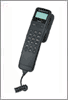
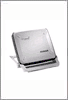
Kenwood DNX9980HD and DNX6980HD incorporate HD Radio and Pandora Internet Radio
The Kenwood DNX9980HD ($2,000 suggested retail), shown at International CES in January 2011, is the company's first multimedia model to incorporate HD Radio and the Pandora Internet Radio link as built-in features.Particularly a handful of in-dash navigation decks that give you touch control over Pandora from the radio screen. All the new in-dash navigation units include free live Navteq traffic. They are satellite and HD Radio-ready and let you make phone calls without losing your view of the navi map due to a split screen function. The exception is the DNX9980 that has built-in HD Radio (where others are only HD Radio-ready). It also has Parrot stereo Bluetooth and voice command control and twin iPod AV control. You operate iPod video and iPod audio as separate sources.All seek, search and "thumbs up/down" functions are replicated on the faceplate of the DNX9980HD, and the 6.95-inch touchscreen display shows full-color album art, song title, album and artist.
The unit also includes built-in Navteq Live Traffic service that is free for the life of the product.2011 DNX Series looks very promising, Fast, Easy to use, Ipod Favorite album makes life on the road much easier. You even have an option to use dual ipods at the same time. Built in 3D Navigation is the coolest thing ever with even better graphics, NOW YOU GET HD Radio for Free… and you can do Sirius with HD at the same time with the 9980HD. Pandora link is built in and is a pleasure to use. You can also now get an OBD2 Adapter that work via Bluetooth and you gauge info will come up on your radio. You can ever check engine codes.
Also now shipping is the double-DIN DNX6980 ($1,200), which comes with built-in Garmin navigation and Parrot Bluetooth. Features include a 6.1-inch WVGA LCD touchscreen panel with navigation/audio/video split-screen view capabilities. This provides the user with complete control over multiple A/V sources, including DVD, MP3/WMA CD, iPod, iPhone, Pandora Internet Radio link, external mass storage devices, satellite radio and HD Radio, the company said, noting that optional iPod, HD Radio, or satellite radio accessories and Internet access may be required.
Both come with two-year warranties and are available only through authorized Kenwood eXcelon retailers.Kenwood started shipping their new DNX9980HD in-dash navigation receiver this week. This is the company’s first model to offer both HD Radio and Pandora Internet Radio link.

For the Pandora Link to work, users will need an iPhone with the Pandora app on it; all the same controls from the app interface will be mimicked onscreen. Album artwork and various visuals get displayed on the 6.95-inch touchscreen as well as the main function: navigation.
The navigation is powered by Garmin and includes realistic looking 3D buildings and landmarks for maps around metropolitan areas. Also, with an optional module, the DNX9980HD will be able to retrieve vehicle data such as fuel consumption, engine temperature and exhaust emissions.
The fully-featured unit also includes built-in Navteq Live Traffic for free and voice recognition for hands-free operation of the navigation system. With all the standard features, it’s going to give many in-car infotainment systems a run for their money — as it should for $2000. But, while the Pandora Link is impressive, I’ve been able to do this with only an Aux jack for a while.

Kenwood’s new flagship double-DIN multimedia / navigation receiver is the DNX9980HD , which is Kenwood’s first multimedia model to incorporate HD Radio and the Pandora internet radio link as built-in features. Along with better sound quality and additional HD Radio-specific programming, the user can enjoy full-color album artwork and other visuals appearing on the touch screen display. New for 2011 is the addition of Pandora internet radio control capability when used with a Pandora-enabled iPhone (Internet access required). All seek, search and “thumbs up/down” functions are replicated on the faceplate of the DNX9980HD, and the 6.95” touch screen display presents full-color album art, song title, album and artist.
Advanced 3-D navigation technology by Garmin is included, offering three-dimensional buildings and landmarks with many images being photo-realistic. Lane Assist with Junction View are two features that reduce highway interchange confusion and improve driving safety. ecoRoute provides the most fuel efficient travel routes, and the optional ecoRoute HD even allows the user to view vehicle diagnostics such as fuel consumption, engine temperature and exhaust emissions (ecoRoute HD requires the optional KNA-EC100 external ODBII interface module). The DNX9980HD also includes built-in NAVTEQ Live Traffic service that is free for the life of the product.
Kenwood’s voice control feature allows the user to fully operate the navigation system and utilize features such as entering addresses or phone numbers, choosing menu options and select points of interest. The voice control system will also operate the audio and video systems, allowing the user to change between multiple sources, access entries in a cellular phonebook, make phone calls, seek out music and video files and access station presets. Twin iPod control allows for the connection and operation of two iPod, iPod Touch or iPhone devices.
The DNX9980HD has an advanced Digital Aria 3-D animated graphic user interface (GUI) with selectable skins and movable, drag-and-drop icons for complete customization. A high-resolution WVGA 6.95” touch screen with Dynamic Brightness Control provides the best looking DVD video, iPod video and USB video. While in the navigation mode, the DNX9980HD can display mapping information as well as audio/video controls on a split screen and will even allow continued monitoring of the navigation screen in split screen view while making or taking hands-free phone calls. The latest Parrot Bluetooth module is built into the DNX9980HD and is capable of A2DP stereo audio streaming from a similarly-equipped portable digital media player or Smartphone.

The double-DIN DNX6980 ($1,200.00 suggested retail price) is a value-added combination of cutting edge technologies, intuitive user interface and great Kenwood eXcelon quality. With the Garmin navigation and Parrot Stereo Bluetooth built right into the unit, the DNX6980 offers the latest in technologies at an attractive price. A compact front-panel knob is included to easily control volume. An upgraded 6.1” WVGA LCD touch screen panel with navigation/audio/video split screen view capabilities give the user complete control over multiple audio and video sources, including DVD, MP3/WMA compact disc, iPod, iPhone, Pandora internet radio link, external mass storage devices, satellite radio and HD Radio (optional iPod, HD Radio or satellite radio accessories and Internet access may be required). The user can customize the GUI and hard-key illumination colors of the DNX6980 to match the unit’s faceplate lighting to the interior lighting of many vehicles, while the background and startup screen graphics can be changed to show personal photos or the brand logo of the vehicle.
The DNX9980HD and DNX6980 come with two-year warranties and are available only through authorized Kenwood eXcelon retailers.Kenwood is launching its first nine automotive head units with Pandora Internet radio control, offering its first head unit with two iPhone/iPod USB ports, and adding HD Radio to an in-dash multimedia/ navigation unit for the first time.At booth 1801, Kenwood is displaying Pandora in all five new in-dash multimedia/ nav systems, in two upper end CD receivers, and in its two mech-less digital media receivers, which lack CD but connect to alternate sources such as iPods and USB drives.
Navigation: The company’s five new A/V-nav products, priced from a suggested $1,150 to $2,000, feature Pandora Internet Radio link and built-in Navteq live traffic free for the lifetime of the product. They also feature a split-screen touchscreen to let users control sources while a map remains on screen.All five feature upgraded Garmin navigation software exclusive to Kenwood in the aftermarket, and all are satellite- ready and HD-ready (except for the top-end $2,000 DNX9980HD with built-in HD Radio). The top-end $2,000 model, part of the step-up Excelon series, adds voice control and twin iPod/USB ports.
Labels: DNX6980, DNX9980HD, HD ready, iPod audio, iPod AV control, iPod video, Kenwood, Navteq traffic, Pandora link, Pandora radio, Parrot stereo
posted by Bob Top @ 2:24 AM
1 comments